
| Home | FAQ | Database | Request | Publications | Acknowledgments |
|---|
DYnamic Atmospheric Shower Tracking Interactive Model Application
DYnamic Atmospheric Shower Tracking Interactive Model Application (DYASTIMA) is a standalone software application for the simulation of the cascades produced in the atmosphere of a planet due to cosmic rays propagation. It is implemented in Geant4 by the Athens Cosmic Ray Group. The input, provided by the user, can be easily parameterized via a very user friendly Graphical User Interface (GUI). The output of DYASTIMA provides all the necessary information about the cascade, such as number, direction, arrival time, energy, and energy deposit of the secondary particles at different tracking layers. With DYASTIMA-R extension, Monte Carlo simulations can be performed on the ICRU sphere (International Commission on Radiation Units and Measurements) or on a human phantom in order to perform radiation dose calculations.
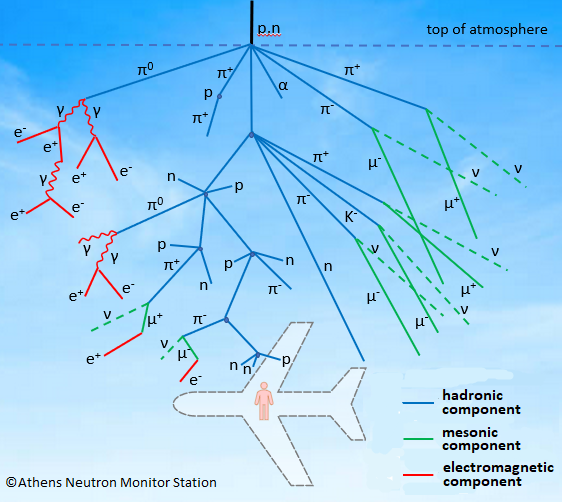 Figure: Cosmic ray cascades in the atmosphere
In this web page the user can find all the necessary information about DYASTIMA, distributed in the following sections:
Figure: Cosmic ray cascades in the atmosphere
In this web page the user can find all the necessary information about DYASTIMA, distributed in the following sections:
Figure: Cosmic ray cascades in the atmosphere
In this web page the user can find all the necessary information about DYASTIMA, distributed in the following sections:
- "FAQ": Provides information about the most common issues. The link to DYASTIMA software is also available there.
- "Database": Provides results from previous runs of specific simulation scenarios.
- "Request": A form where the user is able to request a specific scenario run, not available in the database.
- "Publications": Provides a list of relevant publications as well as a link to the software user manual.
- "Acknowledgments": Acknowledgments and rules regarding the use of data.
Frequently Asked Questions
1. What is DYASTIMA?
DYnamic Atmospheric Shower Tracking Interactive Model Application (DYASTIMA) is a standalone software application for the simulation of the cosmic ray secondary particles cascades that are produced in the atmosphere of a planet. DYASTIMA is an open software developed in Geant4. It can be used by the public and the scientific community with the only requirement being a reference to:
2. How can I download DYASTIMA?
- Paschalis P. et al., New Astronomy 33, 26-37, 2014
- Agostinelli S. et al. (Geant4 collaboration), Nucl. Inst. Meth. A 506, 250-303, 2003
- Allison J. et al. (Geant4 collaboration), IEEE Trans. Nuclear Sci. 53, 270-278, 2006
- Allison J. et al. (Geant4 collaboration), Nucl. Inst. Meth. A 835, 186-225, 2016
The users can run DYASTIMA by downloading it from the external DYASTIMA site (click here).
Operating system requirements and other details can be found in following FAQs. Details on running the application can be found in the User Manual, found in the Publications section.
3. Why DYASTIMA is implemented in Geant4?
Geant4 is a complete toolkit developed in C++ for the simulation of the particles propagation through matter. It covers high and lower energy ranges as well. As a result, it can be used in a variety of applications, such as space science, medical physics, nuclear physics high energy physics, acceleration physics etc. It provides a great variety of options, accuracy as well as good support and updates, while it has more than 1000 citations. Therefore, Geant4 is an excellent environment for the simulation of the secondary particle cascades. The official Geant4 website is http://geant4.web.cern.ch/ in which the necessary references can be found.
4. What are the requirements to perform the simulation?
The requirements for the execution of DYASTIMA are the following:
5. Is it necessary to install DYASTIMA?
- A Microsoft Windows operating system
- The .NET library
- The Geant4 libraries
- The Geant4 datasets
- Enough free disc space, depending on the desired output
- An over-mid-range computer
DYASTIMA performs a simulation in order to study the cascades. For this reason, if the user wishes to perform the simulation for selected input parameters, the downloading of DYASTIMA is necessary. Some pre-fixed scenarios (e.g. solar minimum/ maximum conditions in the Earth’s atmosphere) will be soon available in a database, for a user not wishing to run the software.
6. Is it necessary to install Geant4 to perform the simulation?
To perform the simulations, Geant4 libraries and datasets are required. DYASTIMA can automatically download all the required Geant4 files, allowing the users not to install Geant4 by themselves. More information can be found in the DYASTIMA Software User Manual, provided in the homepage.
7. What does DYASTIMA-R stand for?
DYASTIMA-R is an extension of DYASTIMA implemented in C++ using Geant4. It provides radiation dosimetry calculations by using the output of DYASTIMA. More specifically, the radiobiologigal quantities calculated are dose rate (Gy/h) and equivalent dose rate (Sv/h), as defined by ICRP and ICRU.
8. Are the DYASTIMA-R results validated?
The results provided by DYASTIMA-R are validated according to the International Commission on Radiological Protection (ICRP) as well as the International Commission on Radiation Units and Measurements (ICRU) standards. The ICRU Report 84 provides reference data for ambient-dose-equivalent rates derived from onboard aircraftmeasurementsdue to the exposure to cosmic radiation exposure for:
9. Which are the input parameters?
- three flying altitudes (FL310, FL350, FL390) corresponding to the usual flying range of large passenger-jet aircraft flights,
- eighteen vertical geomagnetic cut-off rigidity values Rc (0 GV to 17 GV, with an increment of 1 GV) corresponding to the full range of geographic latitudes, and
- three time periods (Jan 1998, Jan 2000, Jan 2002) covering different periods of solar activity.
- ICRU: "Reference Data for the Validation of Doses from Cosmic-Radiation Exposure of Aircraft Crew", Journal of the ICRU 10, Report 84, Oxford University Press
- ICRP: "Radiological Protection from Cosmic Radiation in Aviation", ICRP Publication 123, Ann. ICRP 45, 1-48, 2016.
The input parameters are defined by the user via a graphical user interface. The parameters required are:
10. Where the primary cosmic ray spectrum can be found?
- the general characteristics of the planet (radius, surface type, surface pressure, surface gravitational acceleration, magnetic field)
- the structure of the atmosphere (composition and temperature profile)
- the primary cosmic ray spectrum ((particle types, flux, zenith and azimuth range)
- the simulation geometry
- the physics interactions taking place between the cosmic ray particles and the molecules of the planet’s atmosphere (Geant4 reference lists)
- the tracking altitude
- the selection between the flat and the spherical model of the atmosphere
- optional energy cuts for the production, simulation or tracking of particles
There are several models / tools providing the primary cosmic ray spectrum. Indicative examples can be found at:
11. Where the atmospheric structure can be found?
A good approximation of the Earth’s atmosphere is provided by:
12. Why the planet’s magnetic field is necessary?
- the International Standard Atmosphere (International Civil Aviation Organization: "Manual of The ICAO Standard Atmosphere", Doc 7488-CD third ed., 1993)
- τhe US Standard Atmosphere (U.S. Government Printing Office: "U.S. Standard Atmosphere", 1976)
DYASTIMA simulates the propagation of the particles from the top of the atmosphere and below. The magnetic field is not used for the simulation of the travelling of the particles inside the magnetosphere, but for the divergence of the primary and secondary particles’ path in the atmosphere.
13. Where the planet’s magnetic field can be found?
The values of the north, east and vertical Earth’s magnetic field are available by the National Oceanic Atmospheric Administration (http://www.ngdc.noaa.gov/geomag/).
14. Which is the output of DYASTIMA?
The output of DYASTIMA provides all the available information about the secondary particle cascades and tracking, such as:
15. How to set up a simulation scenario?
- number,
- energy,
- direction,
- arrival time and
- energy deposit of the secondary particles at different atmospheric layers.
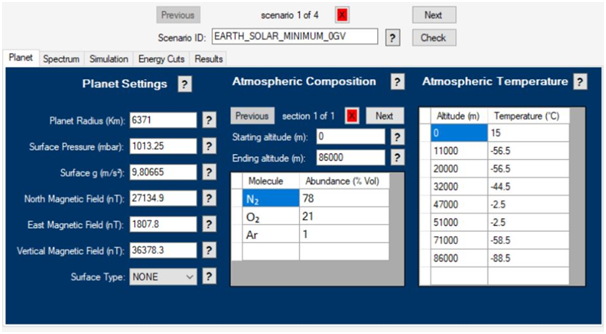
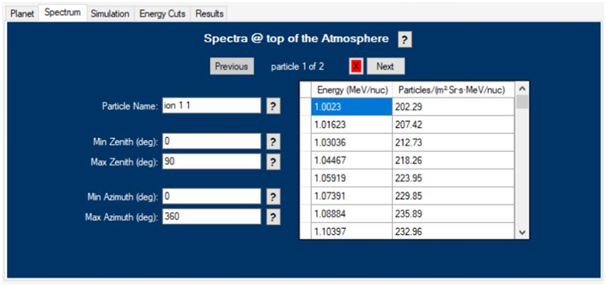
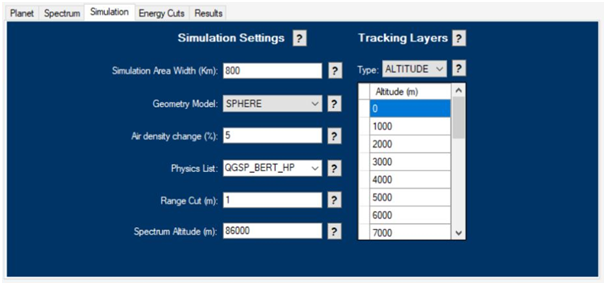
Description: Indicative values for a simulation of the air showers in the Earth’s atmosphere during solar minimum conditions.
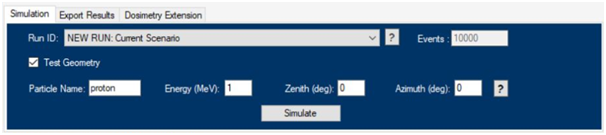
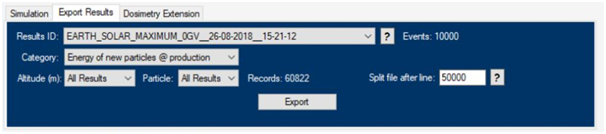
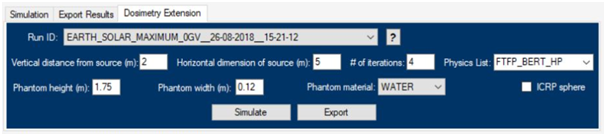
16. How to identify the latest changes in the database?
- The CR spectrum is extracted from CREME model for solar minimum conditions
- The Earth’s atmosphere description is based on the International Standard Atmosphere model
- The values of the magnetic field (north, east and vertical) are found in http://www.ngdc.noaa.gov/geomag
- Tylka J. et al., IEEE Trans. Nucl. Sci. 44, 2150-2160, 1997
- Weller R. A. et al., IEEE Trans. Nucl. Sci. 57, 1726-1746, 2010
- Mendenhall M. H. and Weller R. A., Nucl. Inst. Meth. A 667, 38-43, 2012
- International Civil Aviation Organization, Doc 7488-CD third ed., 1993
- ICRP, ΙCRP Publication 123, Ann. ICRP 42, 2013
- ICRU, J. ICRU 10, Report 84, Oxford University Press, 2010
The uploading date of each scenario included in the database is indicated next to the title of the corresponding scenario. In this way the user can identify the latest scenarios.
Database
In this section, results of previous runs are provided. Each run corresponds to a specific simulation scenario, hence, specific conditions for the planet, the atmosphere, the cosmic ray spectra and the simulation parameters. A description of each simulation scenario is given along with the corresponding results.
Earth |
||
Venus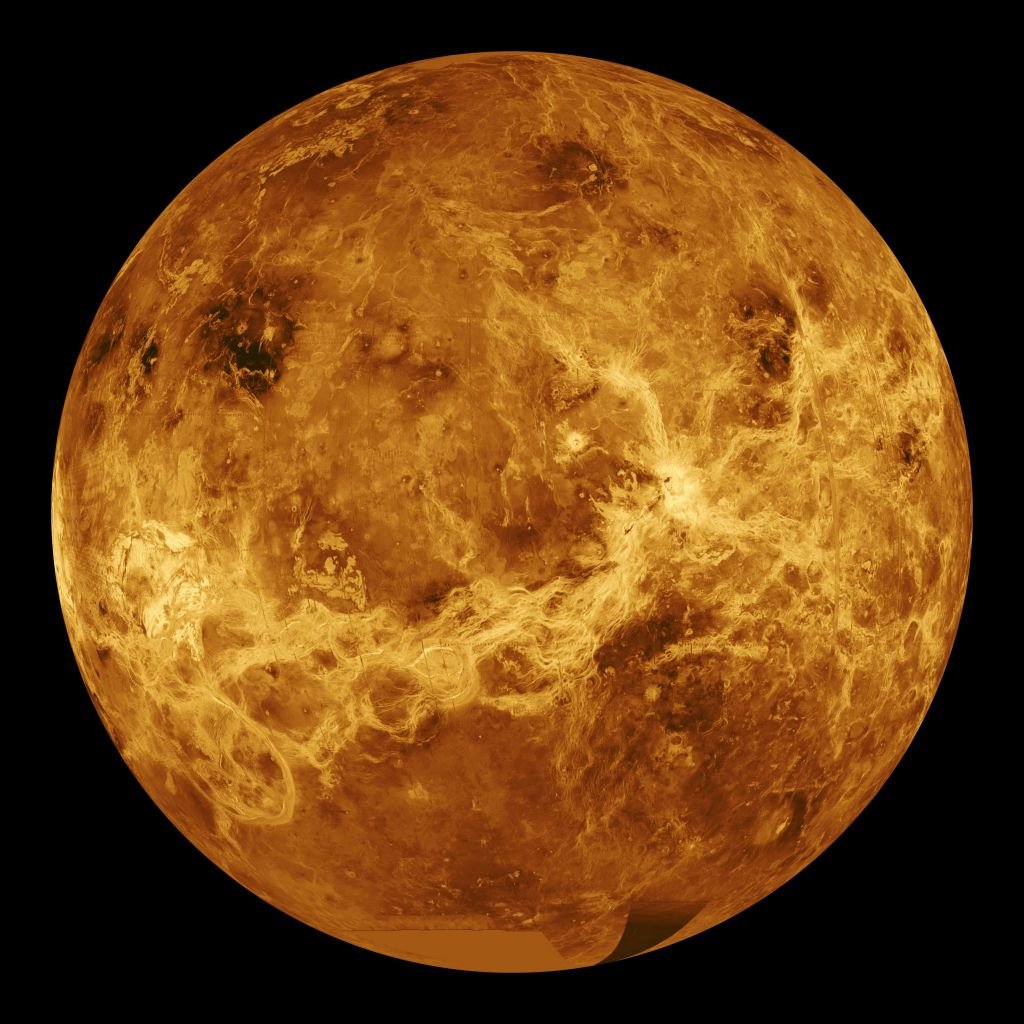 |
||
Mars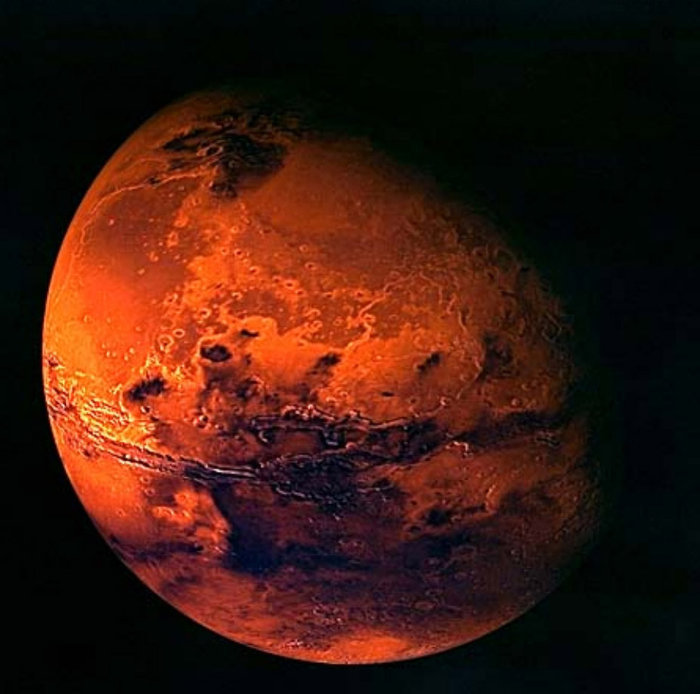 |
||
Saturn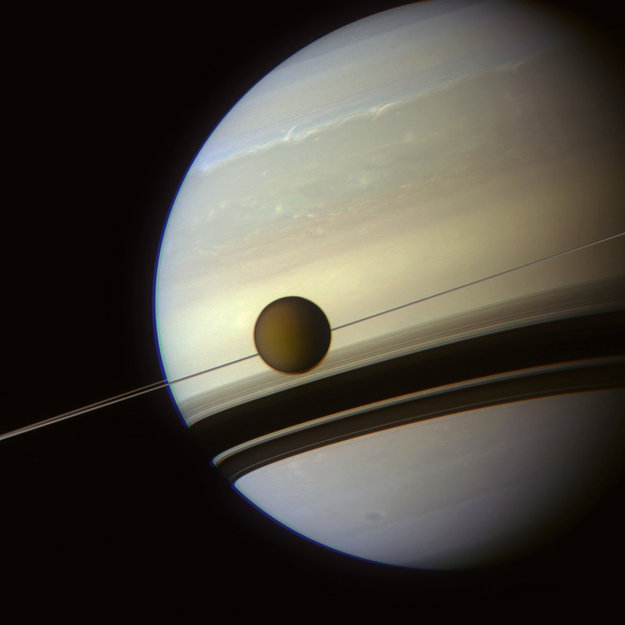 |
||
Titan |
Request
Feel free to suggest a scenario as an addition to our database.
Your proposal must include the following:
a. A statement of the objectives and the usage purpose of the specific scenario
b. The necessary inputs for the simulation. These may be provided through a file (.xls, xlsx, .doc, .docx, .pdf) filled with the necessary information. If this is not possible you can provide us with references containing the necessary inputs.
All requested scenarios undergo an evaluation process. The results of the ones that are simulated will be found in the Database section. The users will be informed by email when the results are available.
Please fill in the request form. Fields with (*) are mandatory.
1) Please use the following references when publishing results that have been produced by this site. Additionally, we would like to hear from you regarding when and where your paper will be published.
a. P. Paschalis et al., New Astronomy, 33, 26-37, 2014 (https://doi.org/10.1016/j.newast.2014.04.009) b. Geant4 according to the conditions indicated at https://geant4.web.cern.ch/ 2) Results of the requested scenario will be available in the database for any (further or future) use to all users. 3) Submission of the application does not imply an obligation of implementation. All applications will undergo an evaluation process. I accept all terms and conditions. After successful submission, an automatic confirmation will be sent to the provided email address. In case you do not receive this message, please contact the helpdesk at helpdesk.swe@esa.int
Your proposal must include the following:
a. A statement of the objectives and the usage purpose of the specific scenario
b. The necessary inputs for the simulation. These may be provided through a file (.xls, xlsx, .doc, .docx, .pdf) filled with the necessary information. If this is not possible you can provide us with references containing the necessary inputs.
All requested scenarios undergo an evaluation process. The results of the ones that are simulated will be found in the Database section. The users will be informed by email when the results are available.
Please fill in the request form. Fields with (*) are mandatory.
Request
Terms and conditions| Scenario description(*) | ||
|---|---|---|
| Purpose of scenario(*) | ||
| Area of interest(*) | ||
| References(*) | ||
| Simulation input | (Maximum file size is 5 MB) |
1) Please use the following references when publishing results that have been produced by this site. Additionally, we would like to hear from you regarding when and where your paper will be published.
a. P. Paschalis et al., New Astronomy, 33, 26-37, 2014 (https://doi.org/10.1016/j.newast.2014.04.009) b. Geant4 according to the conditions indicated at https://geant4.web.cern.ch/ 2) Results of the requested scenario will be available in the database for any (further or future) use to all users. 3) Submission of the application does not imply an obligation of implementation. All applications will undergo an evaluation process. I accept all terms and conditions. After successful submission, an automatic confirmation will be sent to the provided email address. In case you do not receive this message, please contact the helpdesk at helpdesk.swe@esa.int
Publications
User Manual
- The Software User Manual for DYASTIMA can be found here
- Paschalis P., Mavromichalaki H., Dorman L.I., Plainaki C., Tsirigkas D.: "Geant4 software application for the simulation of cosmic ray showers in the Earth's atmosphere", New Astronomy 33, 26-37, 2014.
- Paschalis P., Tezari A., Gerontidou M., Mavromichalaki H., Nikolopoulou P.: "Space Radiation exposure calculations during different solar and galactic cosmic ray activities", XXV ECRS 2016 Proceedings - eConf C16-09-04.3, 2016.
- Plainaki C., Paschalis P., Grassi D., Mavromichalaki H., Andriopoulou M.: "Interactions of cosmic rays with the Venusian atmosphere during different solar activity conditions", Annales Geophysicae 34, 595-608, 2016.
- Paschalis P., Tezari A., Gerontidou M., Mavromichalaki H., Karaiskos P., Crosby N., Dierckxsens M.: "Integration of DYASTIMA to European Space Agency",15th European Space Weather Week, Leuven, Belgium, 5 - 9 Nov 2018.
- Paschalis P., Tezari A., Gerontidou M., Mavromichalaki H.: "Monte Carlo Radiation Dose Calculations in Geospace", 26th Extended European Cosmic Ray Symposium and 35th Russian Cosmic Ray Conference, Altai, Russia, 6 – 10 Jul 2018.
- Paschalis P., Tezari A., Gerontidou M., Mavromichalaki H., Karaiskos P.: "Radiation exposure of aircrews due to Space Radiation", 27th Annual Symposium of the Hellenic Nuclear Physics Society, Athens, Greece, 8 - 9 Jun 2018.
- Paschalis P., Tezari A., Gerontidou M., Mavromichalaki H.: A tool for space radiation exposure calculations for aviators, 14th European Space Weather Week, Oostende, Belgium, 26 Nov – 1 Dec 2017.
- Paschalis P., Tezari A., Gerontidou M., Mavromichalaki H.: "Space radiation study based on cascades simulations in geospace", 14th European Space Weather Week, Oostende, Belgium, 26 Nov – 1 Dec 2017.
- Paschalis P., Tezari A., Gerontidou M., Mavromichalaki H.: A new tool for space radiation exposure calculations, "10 Years" NMDB Workshop, Athens, Greece, 20 – 23 Mar 2017.
- Paschalis P., Tezari A., Gerontidou M., Mavromichalaki H., Ioannidou S.: "Space Radiation Exposure Simulation During Different Phases of Solar Activity", Health Physics Society 50th Midyear Meeting, Bethesda, Maryland, 22-25 January 2017.
- Paschalis P., Tezari A., Gerontidou M., Mavromichalaki H.: "A new tool for radiation exposure calculations in aircraft flights during disturbed solar activity periods", European Geosciences Union General Assembly 2016, Vienna, Austria, 17–22 Apr 2016.
- Agostinelli S., Allison J., Amako K., Apostolakis J. et al. (Geant4 collaboration): "Geant4-a simulation toolkit", Nucl. Inst. Meth. A 506, 250-303, 2003.
- Allison J., Amako K., Apostolakis J. et al. (Geant4 collaboration): "Geant4 developments and applications", IEEE Trans. Nuclear Sci. 53, 270-278, 2006.
- Allison J., Amako K., Apostolakis J. et al. (Geant4 collaboration): "Recent developments in Geant4", Nucl. Inst. & Meth. A 835, 186-225, 2016.
- Geant4, https://geant4.web.cern.ch/
- SPENVIS, https://spenvis.ssa-swe.eu/ and https://www.spenvis.oma.be/
- OMERE, http://www.trad.fr/en/space/omere-software/
- Tylka A.J., Adams J. H., Boberg Jr., P. R., Brownstein B., Dietrich W. F., Flueckiger E. O., Petersen E. L., Shea M. A., Smart D. F., Smith E. C.: "CREME96: A Revision of the Cosmic Ray Effects on Micro-Electronics Code", IEEE Trans. Nucl. Sci. 44, 2150-2160, 1997.
- Weller R.A., Mendenhall M. H., Reed R. A., Schrimpf R. D., Warren K. M., Sierawski B. D., Massengill L. W.: "Monte Carlo simulation of single event effects" IEEE Trans. Nucl. Sci. 57, 1726-1746, 2010.
- Mendenhall M. H. and Weller R. A.: "A probability-conserving cross-section biasing mechanism for variance reduction in Monte Carlo particle transport calculations", Nucl. Inst. Meth. A 667, 38-43, 2012.
- CRÈME, https://creme.isde.vanderbilt.edu/
- International Civil Aviation Organization: "Manual of The ICAO Standard Atmosphere", Doc 7488-CD third ed., 1993.
- U.S. Government Printing Office: "U.S. Standard Atmosphere", 1976.
- ICRP: "Radiological Protection from Cosmic Radiation in Aviation", ICRP Publication 123, Ann. ICRP 45, 1-48, 2016.
- ICRP: "Assessment of Radiation Exposure of Astronauts in Space", ICRP Publication 123, Ann. ICRP 42, 2013.
- ICRU: "Reference Data for the Validation of Doses from Cosmic-Radiation Exposure of Aircraft Crew", Journal of the ICRU 10, Report 84, Oxford University Press, 2010.
Acknowledgments
This web page forms part of the European Space Agency's network of space weather services and service development activities, and is supported under ESA contract number 4000134036/21/D/MRP.
For further product related information or enquiries contact the helpdesk. E-mail: helpdesk.swe@esa.int
All publications and presentations using data obtained from this site should acknowledge Athens Neutron Monitor Station of National and Kapodistrian University of Athens and The ESA Space Safety Programme.
For further information about space weather in the ESA Space Safety Programme see: www.esa.int/spaceweather
Access the ESA SWE Portal here: swe.ssa.esa.int